
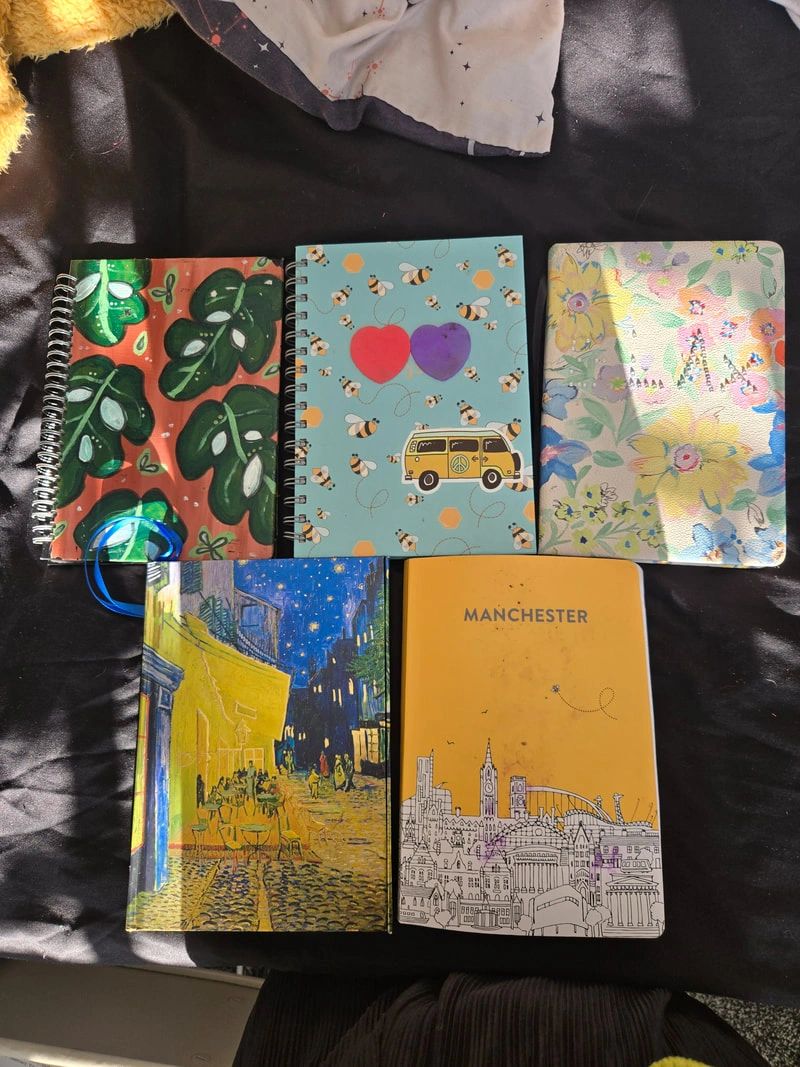
Anyone who knows me at all will know I’m a huge journaling fan. I started my first journal more than four years ago at the age of 16, and I’m now on my fifth. I’ve gone through phases where I didn’t journal for a while but after the events of the past few months, I have no plan to stop anytime soon; it’s satisfying to reflect on how far I’ve come. While it started as simply writing about the most boring parts of my day, it’s since become a space where I process difficult emotions, and I’ve even incorporated a few other ideas to diversify it. This post is going to explore my journaling routine and how I use it for my mental health and to keep myself on track with my goals. If you’re curious about starting a journal, you might find some inspiration here for adding to your own.
My daily journaling routine
At the end of every day, I write a page about what happened. Sometimes it’s more than a page if a lot has happened or if I have something I want to fully unpack. Sometimes it’s less than a page if I feel I have nothing to write about, but I do try to find something to at least fill a page.
Something I’ve recently added to help me think more positively, is what I’ve named my ‘smile list’: three things that happened during the day that made me feel happy or proud. At first it was a gratitude list, but I’d then feel pressured to think of new things every day which I couldn’t always do. Sometimes, if I can’t think of three, I will also add small things I’m grateful for, such as ‘my eyes for showing me the world’s beauty’.
When I have more time
If I have a quiet afternoon and feel like writing, I do my own take on something called ‘morning pages’. The idea is to fill three pages with a stream of consciousness, except I normally call it ‘afternoon pages’ because that’s when I tend to do it. With this, I will write three pages no matter what and it’s interesting to see what arises. Sometimes it turns into a to-do list, other times a venting session – it can be rather unpredictable since I never go into it with a specific intention.
At the end of the month
I like to read back through all my journal entries at the end of each month so I can then write an entry titled “What am I proud of this month?”. I started doing this last year as another way to reflect and remind myself of the good things I’ve accomplished, especially because our brains tend to fixate on the bad.
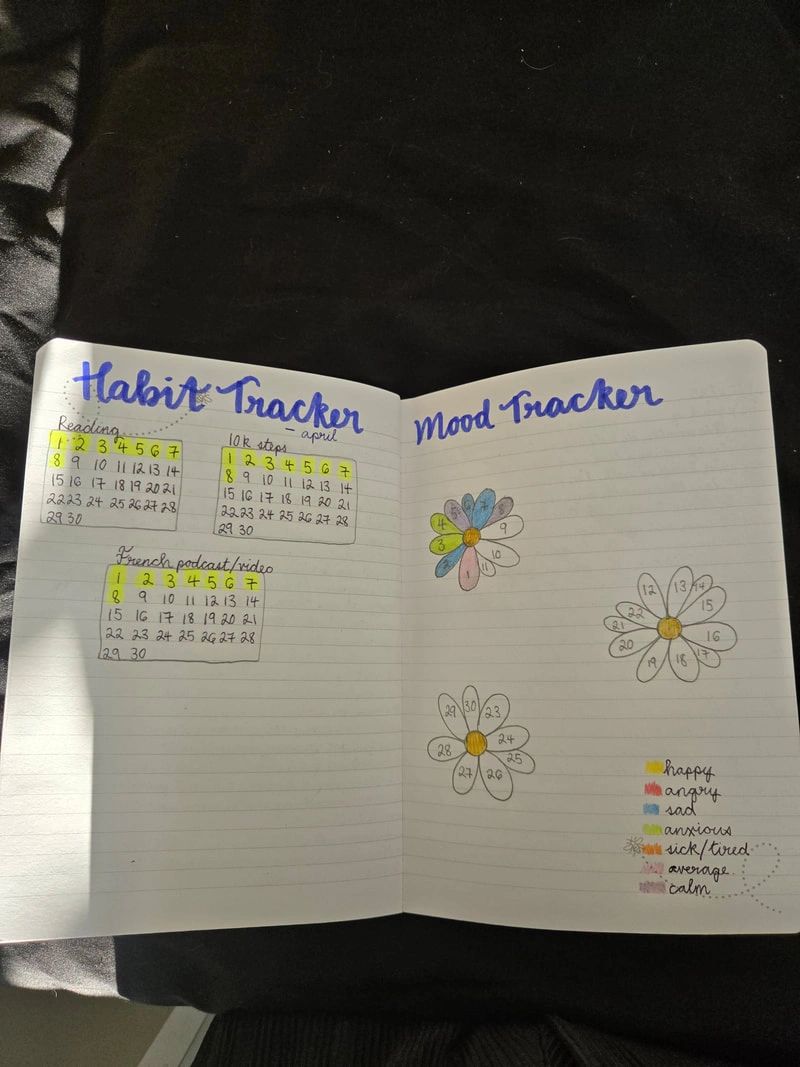
I’ve also started making habit and mood trackers for each month. My habit tracker is comprised of a small grid where I highlight each day I did one of my habits. For this month, the three habits I have are: reading, doing 10,000 steps, and watching a French video or listening to a French podcast. As of writing this (the 7th April), I’ve done all of them every day this month! It’s a highly effective way of keeping myself both accountable and motivated because I get a little dopamine hit from colouring in each square.
My mood tracker this month is a flower design I found on Pinterest where each petal represents a day, and I colour them based on my mood. Pinterest is my go-to for journaling prompt ideas or templates. I’d definitely recommend checking it out if you’re ever stuck.
At the start of the month
Following on from my end-of-month reflections, I start the month with an entry titled “What are my goals for this month?”. It helps me plan out my tasks and how I’m going to manage them. When it comes to the end of that month, I can read back over and see what I did or didn’t do. If there’s anything I didn’t manage to get done, I can prioritise it for the following month so it doesn’t linger as an endless mental to-do.
Book reviews
Since I’ve now started to read quite a bit, I write reviews in my journal for every book I finish. I include the title, author, genre, number of pages, and year published, as well as a rating out of five stars and a small paragraph of what I thought about it. When I first started writing these, I would also have a rating for ‘tears’ and ‘spiciness’ because of a template I found online, but these aren’t really relevant to the books I tend to read, so I’ve simplified it to a star system.
There have been other things I’ve added to my journal on occasion, but these are what I use it for regularly. Journaling is a deeply personal activity so if your journal looks completely different, carry on doing what works for you. Some people like to use theirs as more of a creative outlet where they will add drawings or make scrapbook-style pages, but I prefer to stick to writing.
Sometimes I think that I want to add other ideas to my journal, like reviews for film reviews alongside books ones, but I find that trying to track too many things can make journaling feel like a chore. It can remove the fun out of the thing you’re doing, like watching the film in this example. That’s why my recommendation to anyone wanting to start journaling is not to put pressure on yourself to write every day – just do whatever you can manage. Any writing is better than none.
Leave a Reply